Why the same apartments are producing very different outcomes, and what it means for investors.
Every real estate cycle teaches the same lesson in a new form. Good assets rarely ruin investors. The wrong debt does.
This cycle, the lesson is showing up in apartments. In September, the delinquency rate on apartment loans in commercial mortgage-backed securities rose 35 basis points to 8.04%, according to Trepp. That is above the 8.02% rate across all commercial property types combined, which is itself the highest level since November 2020.
Read that number alone and the conclusion is that apartments are in trouble. It is the wrong conclusion, and acting on it is how investors miss the opportunity in front of them.
The full data tells a different story.
Same asset. Different outcomes.
Break the data out by lender, and the picture changes completely.
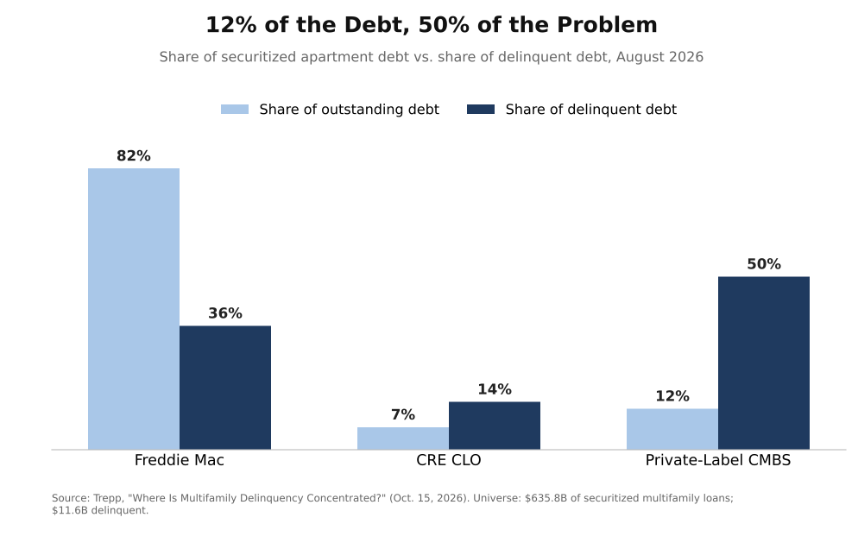
Trepp tracks $635.8 billion of securitized apartment debt across three channels. Loans backed by Freddie Mac, 82% of the total, carried a delinquency rate of 0.80% in August. Loans in private-label CMBS carried 7.69%, more than double where they stood two years earlier.
Same property type. Same national rental market. Same interest rate environment. Under 1% in one channel, nearly 8% in the other.
The difference is not the real estate. It is the debt, the underwriting standard behind it, and the discipline of the people who structured it.
Where the distress actually sits
Private-label CMBS holds 12% of securitized apartment debt and half of the $11.6 billion that is delinquent. Freddie Mac holds 82% of the debt and roughly a third of the delinquencies.
One caution on the numbers. CRE CLOs, which mostly hold floating-rate transitional loans, show a lower delinquency rate today than two years ago. That does not mean the problem healed. As Trepp notes, CLO managers can remove distressed loans from their pools. A number that improves because the bad loans were moved is not an improving number.
Why this matters now
Relief is not coming from the Fed. In September, the Fed raised rates for the first time since July 2023, and its own projections call for one more increase this year. The 10-year Treasury stood at 5.00% on October 23.
Owners who financed on the assumption that rates would fall are running out of time and options. Their problem will become someone else’s opportunity. The question is who will be positioned to take it.
What disciplined investors should do
- Underwrite the capital structure before the property. When was it bought, at what basis, with what debt, maturing when?
- Ask whether the sponsor can actually operate. In a flat market, returns come from management, not appreciation.
- Treat distress as a pricing event, not a verdict on the asset class. Good buildings with broken capital structures will trade at prices that reflect the debt, not the real estate.
Apartments remain one of the most durable assets in real estate. That has not changed. What this cycle is teaching, again, is that a good asset with the wrong debt is still a bad investment.